

Cucumber Trial: More Yield for Less Spend with Pre-Plant and Foliar Nutrition
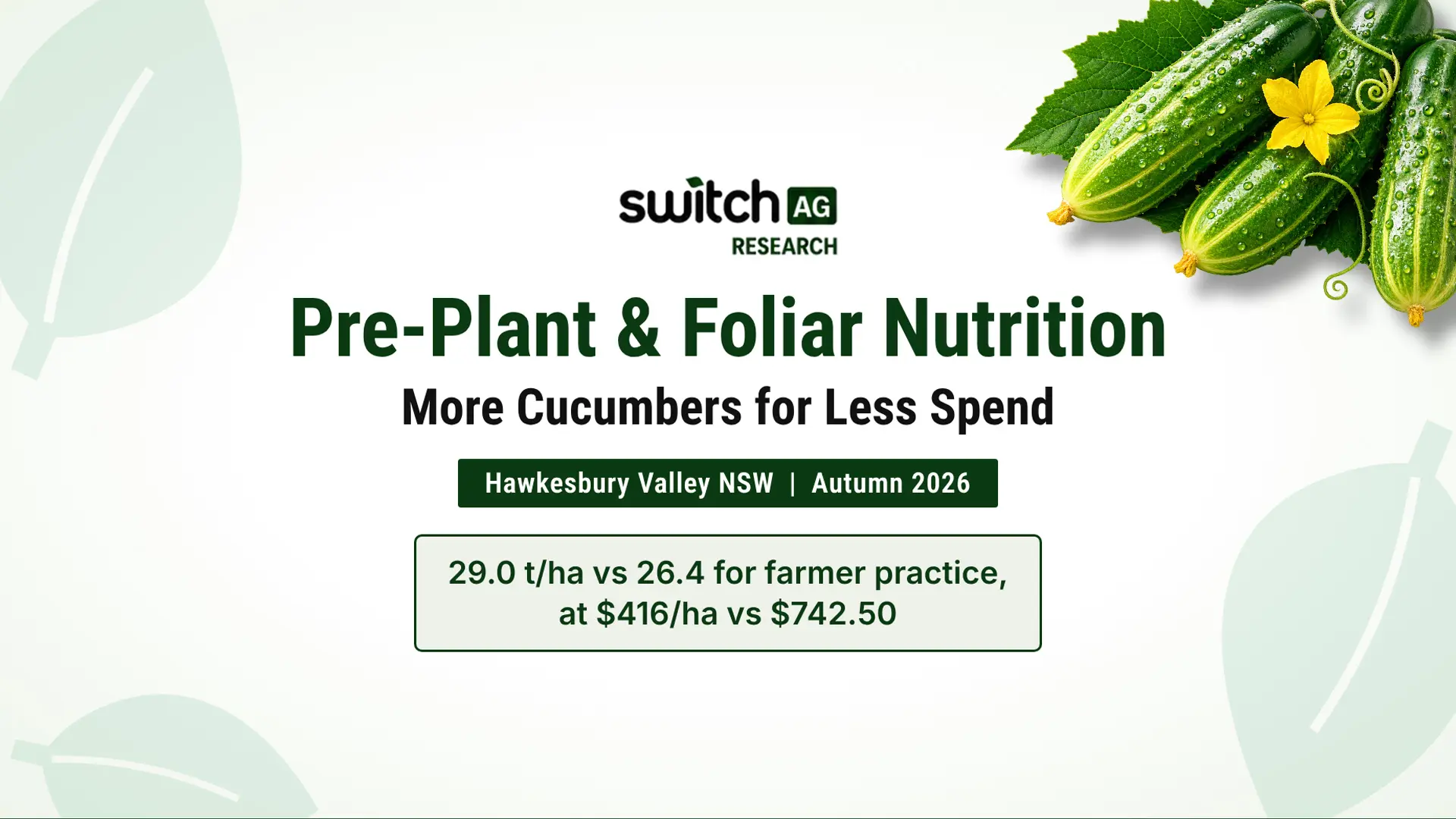
In autumn 2026, Switch Ag Research ran a randomised, replicated field trial on a one hectare commercial crop of field-grown cucumbers in the Hawkesbury Valley, NSW, testing a pre-plant and foliar program against the grower's standard practice. Five treatments, five replicates each, harvested six weeks after planting on 13 April 2026.
The best-performing program grew 29.0 tonnes per hectare against 26.4 for farmer practice, with a heavier average fruit (109.6 grams against 93.2), and it did it for $416 per hectare of inputs against $742.50. Put together, that is 96 per cent more yield for every dollar spent on nutrition.
Here is what was tested, what came out of it, and what it means if you are growing vegetables on high-fertility ground.
The problem the trial was built around
Pre-trial soil testing showed a paddock that was anything but short of nutrients: high nitrate nitrogen, high phosphorus, high potassium, adequate to high sulphur and boron. What it lacked was structure to hold them. Soil carbon sat near 0.5 per cent and cation exchange capacity below 12, so the soil behaved like a sand with little capacity to bind nutrients for exchange.
That combination works against calcium. High nitrate and potassium can antagonise calcium uptake, and calcium is what a fast cucumber crop relies on for cell wall integrity, fruit quality and yield stability. So the question was never "how do we add more fertiliser". It was "how do we get better uptake and balance out of what is already there".
The treatments
The control was the grower's standard program: 450 kilograms per hectare of NPK 12:5:14 plus a trace element foliar.
Every Switch Ag treatment started the same way. EnviroCal at 2 kilograms per hectare and Promote at 10 litres per hectare went on together by boom spray to the soil surface at planting, before the crop emerged. From there a foliar program ran through the crop: Promote at 2.5 litres per hectare each week for five weeks, with FortiCal, a calcium foliar with magnesium and boron, at 5 litres per hectare in weeks two and five, a trace mineral foliar in weeks one and four, and Crop-K in week three.
- Base program: the pre-plant application and the foliar program, nothing else.
- Base plus a second calcium: the same program with a competitor's foliar calcium product added in weeks two and five.
- Base plus Guano: the same program with Microfert Guano Granules side-dressed at planting at 250 kilograms per hectare.
- Base plus Guano and Carbon: the same program with Microfert Guano and Microfert Carbon Granules side-dressed at planting, 125 kilograms per hectare of each.
No synthetic NPK was applied to any Switch Ag treatment.
What came out of it
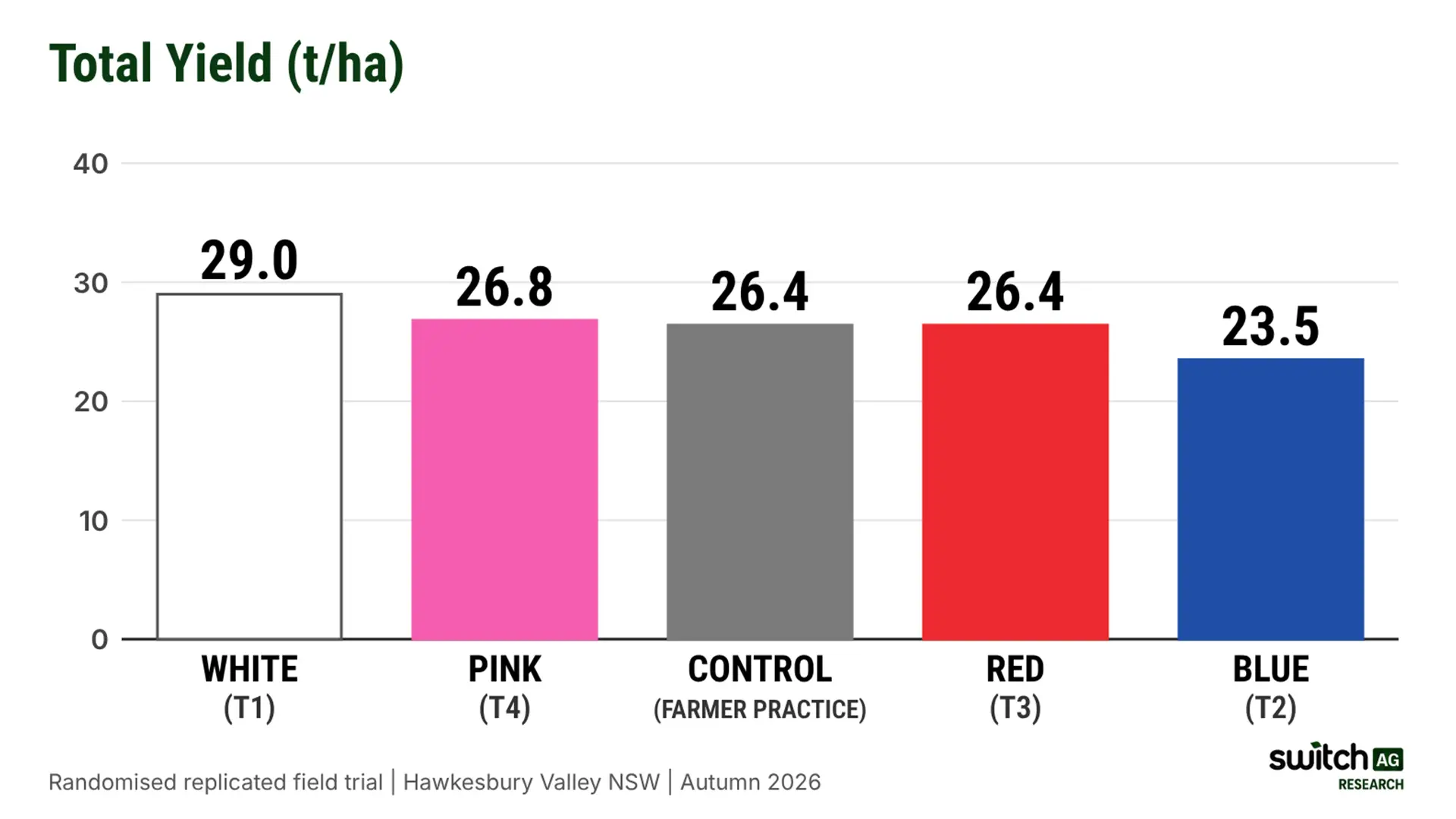
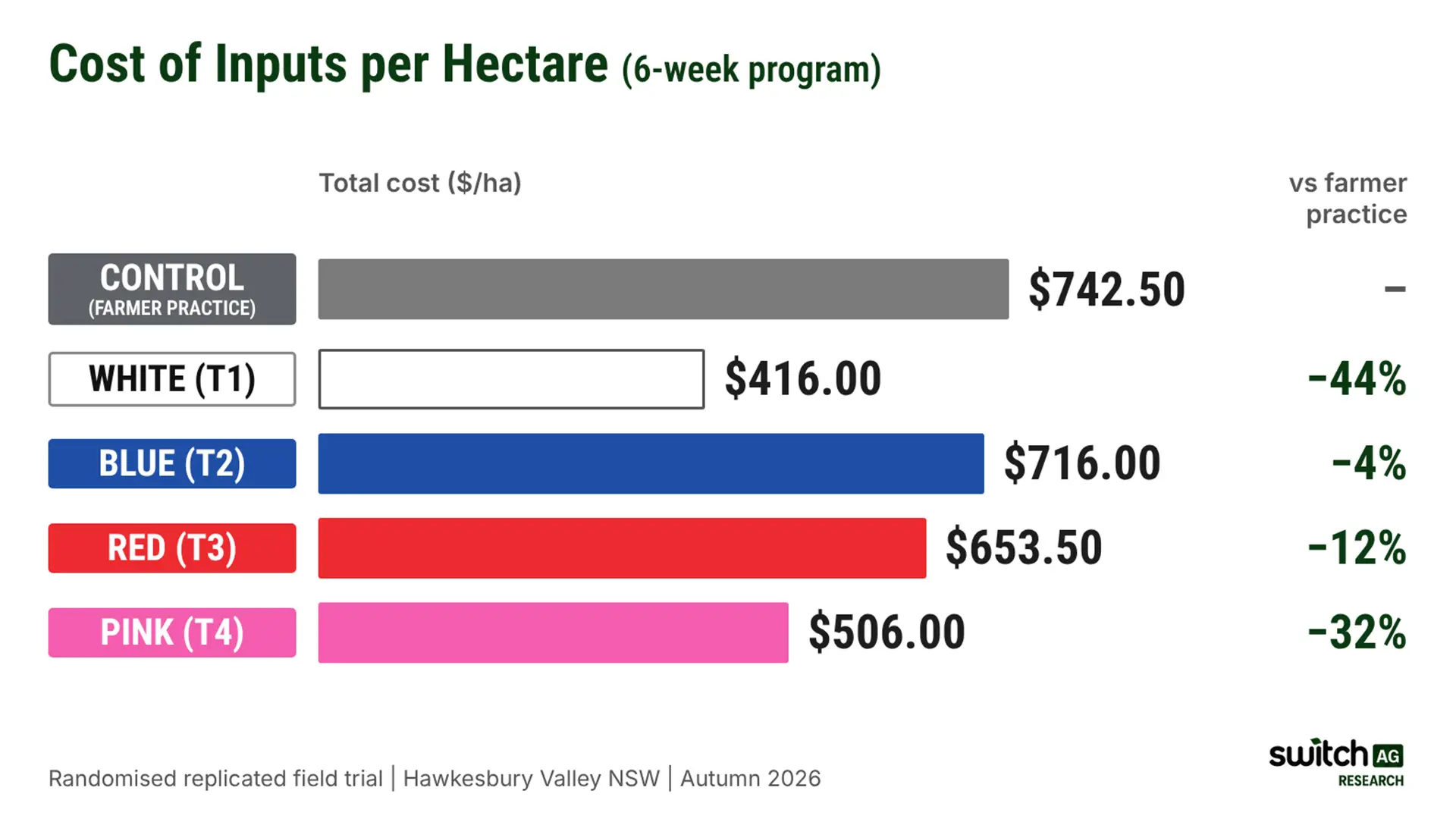
| Treatment | Yield (t/ha) | Average fruit weight (g) | Program cost ($/ha) | Yield per dollar vs farmer practice |
|---|---|---|---|---|
| Farmer practice (control) | 26.4 | 93.2 | 742.50 | baseline |
| Base program | 29.0 | 109.6 | 416.00 | +96% |
| Base plus a second calcium | 26.8 | 92.9 | 506.00 | +49% |
| Base plus Guano and Carbon | 26.4 | 87.0 | 653.50 | +14% |
| Base plus Guano | 23.5 | 82.5 | 716.00 | -8% |
Three things stand out.
The simplest program won. EnviroCal and Promote at planting, the foliar program through the crop, and nothing else, gave the highest yield, the heaviest fruit and the lowest cost of any treatment.
More calcium did not mean more yield. The trial also benchmarked a competitor's foliar calcium product, added on top of the base program. Leaf calcium went up; yield did not. That treatment came in at 26.8 tonnes per hectare against 29.0 for the base program, for $90 more per hectare. What did show through the tissue data was that repeated calcium applications did more than any single one, and that sampling seven days after an application gave the only reliable read of calcium moving into the plant.
Guano did not pay in a six-week crop on this ground, and that is worth knowing. Soil phosphorus was around ten times what a cucumber crop needs, so adding more had nowhere to go in the time available. Microfert Guano and Carbon Granules are built to work on the soil over time, building phosphorus capital and organic carbon, so a six-week crop was never going to show their value. Darren Fahey, who ran the trial, expects it in the crops that follow on that block. Kenny Case, who grew the crop, assessed the fruit at harvest and saw better consistency in fruit size in the guano-treated area and a slightly improved seed cavity across the treated blocks, which matters when fruit is headed for brining and wasted fruit is the real cost.
What it means for your vegetable program
If your soil test is already reading high, more fertiliser is unlikely to be the answer, and it may be the problem. Switch Ag's recommendations out of this trial are simple: EnviroCal and Promote on the soil at planting to support early growth, a foliar program through the crop with FortiCal in it, and a tissue sample seven days after application to see whether it is getting in. Focus on balance and uptake, not more fertiliser.
Start with the crop, not the drum. Conduct a health check on your crop through Tissue, SAP and or Soil Testing to identify any nutrient deficiencies or imbalances that need rectifying, and Switch Ag will put together the program to correct them so the crop can realise its yield potential.
Talk to a Switch Ag agronomist about a pre-plant and foliar program for your vegetable crop: admin@switchag.au or 0411 156 839.